
6 Japanese Concepts for a Fulfilling Life
Philosophies & Mindsets for Everyday Living
TL;DR
Japanese life philosophies focus less on fixing yourself and more on how you move through life. Concepts like ikigai, kaizen, and wabi sabi emphasize purpose, presence, patience, and harmony. When practiced through small mindset shifts and daily habits, they can lead to greater peace, clarity, and a more fulfilling way of living.
Japanese Concepts for a Fulfilling Life
Grow Through What You Go Through
Growth is often framed as something active: fixing, improving, becoming. But some of the most meaningful growth happens quietly, when we stop pushing and start paying attention. When we begin to notice how we move through our days, how we respond to discomfort, and how we define purpose and progress.
There are several Japanese philosophies that offer a softer, more grounded way forward. Rather than focusing on constant self improvement, they center on presence, patience, and how we relate to ourselves and others. These ideas are not about chasing happiness or reinventing your life. They are about learning how to live more fully within it.
The concepts discussed did not come from modern self help culture. They grew out of everyday life. They were shaped by how people worked, endured hardship, built community, and found meaning in ordinary moments. While deeply rooted in Japanese culture, their wisdom is not limited by geography. They reflect shared human experiences, shaped by habit, perspective, and time.
The philosophies explored here are not rules to follow or ideals to reach. They are perspectives you can return to when life feels heavy, rushed, or unclear. Small mindset shifts in how you think, notice, and act can gradually change how life feels. That is where real growth begins.
Some of the links on this page are affiliate links. This means if you click on a link and make a purchase, Fresh Beauty Tips may earn a small commission, at no extra cost to you. We only recommend books we believe are helpful for keeping your mind growing and glowing.
Ikigai
Reason for Being: Your Purpose
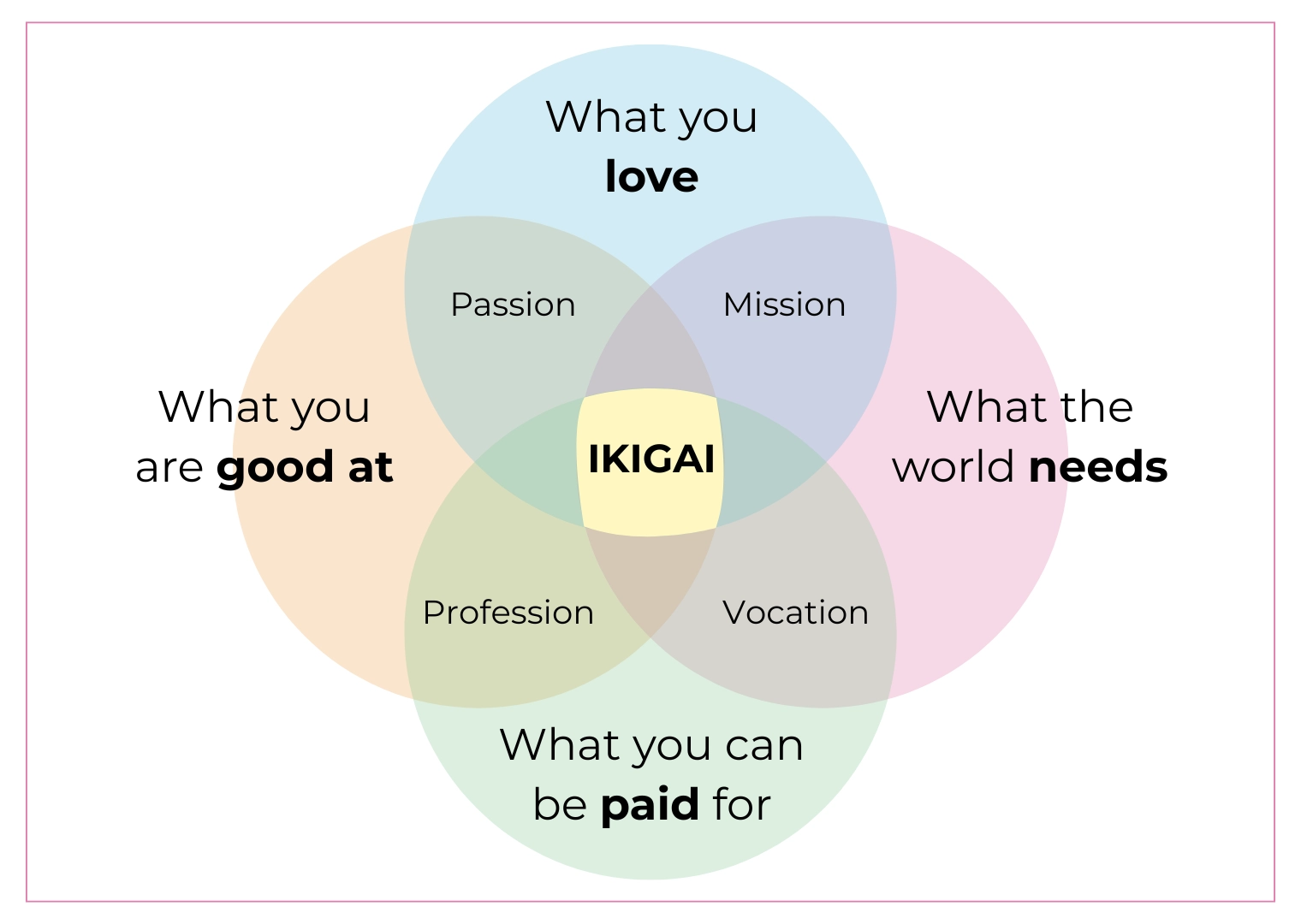
Ikigai (生き甲斐) literally means “that which makes life worth living.” This Japanese concept is not about passion or reaching milestones in the modern sense, and it is not a destination to reach. Instead, ikigai lives in the overlap between what you care about, what you’re naturally inclined toward, how you contribute, and how you sustain yourself. More than anything, it is the quiet sense of worth that infuses ordinary activities and gives shape to everyday life.
Rather than asking you to chase meaning, ikigai invites you to notice it. It shows up in the work you take pride in, the relationships you nurture, and the routines that make your days feel anchored. Having a sense of purpose (even a modest one) helps focus daily energy, reducing aimlessness and emotional drift, and supporting long term motivation and wellbeing.
Historically, ikigai emerged organically from daily life in Japan, particularly among older generations who remained engaged through routine, responsibility, and contribution well into later years. Purpose was not something to “find,” but something expressed through showing up for your family, your craft, or the community. The concept was later studied academically in the 1960s and introduced more widely through modern research and books such as Ikigai: The Japanese Secret to a Long and Happy Life, which brought renewed global attention to this way of thinking.
How to find your ikigai
To find your ikigai, start by paying attention to what quietly energizes you, those moments that make time feel less heavy or help you lose track of it altogether. Notice your strengths, especially the ones others naturally see in you. Don’t be afraid to ask those close to you if you feel stuck; others tend to notice these traits in us, even more than we recognize in ourselves sometimes. Write them down. From there, consider how these interests and abilities might serve others, something beyond yourself, regardless of how small it may be. That will help you begin your ikigai journey towards finding your ‘why.’
Just remember, your ikigai is not discovered all at once; it is shaped through action. Like Dolly says: just shine, design, refine until they come true. Start with small daily habits and gentle experiments, allowing meaning to emerge through consistency, which leads naturally to the idea of kaizen.
Kaizen
Continuous Improvement: Small Changes That Last
Kaizen (改善) means “change for the better,” and it refers to the practice of continuous, incremental improvement. Rather than focusing on dramatic transformation or overnight success, kaizen emphasizes steady progress through small, manageable changes. It is a philosophy rooted in patience, consistency, and respect for the process of growth.
At its core, kaizen shifts the way we think about improvement. Instead of asking how to fix everything at once, it asks what can be adjusted today. This approach reduces overwhelm and removes the pressure to be perfect. Consider a staircase; the idea of reaching the top may seem impossible, but if you take a single step each day, making it to the top is no longer out of reach. Small steps feel achievable, which builds confidence and momentum over time. In daily life, kaizen supports wellbeing by replacing all or nothing thinking with curiosity and progress.
Historically, kaizen became widely recognized in Japan after World War II, particularly in manufacturing and business, where it helped rebuild industries through collective responsibility and gradual refinement. However, its origins extend beyond the workplace. The mindset reflects long standing cultural values of discipline, patience, and long term thinking. Over time, kaizen became a way of approaching life itself, not just work.
How to practice kaizen
To practice kaizen, start by choosing one small area of your life that feels slightly misaligned. Perhaps you work too much, or don’t exercise as much as you’d like. Do not aim to overhaul it. Instead, ask what one tiny improvement might look like. It could be five minutes of movement, drinking more water, or adjusting a daily routine (like no work calls after 7:00 PM). Commit to consistency rather than intensity. Pay attention to what works and what does not. Adjust gently without judgment.
Over time, these small changes compound, creating meaningful growth that feels sustainable rather than exhausting. Steady habits that build over time are much more like to ‘stick’. Robert Maurer’s book One Small Step Can Change Your Life offers great guidance and practical steps to implement this concept into your daily life.
Ichigo Ichie
Once in a Lifetime: Being Present
Ichigo ichie (一期一会) translates to “one time, one meeting,” and it reflects the idea that each moment is unique and unrepeatable. Even if a situation feels familiar, the exact conditions of that moment will never occur again. This concept encourages presence, appreciation, and attentiveness to what is happening right now.
In practice, ichigo ichie invites you to slow down and fully experience moments that might otherwise pass unnoticed. Conversations, routines, and ordinary interactions take on new significance when viewed through this lens. By focusing on the present rather than replaying the past or anticipating the future, mental noise quiets and clarity increases. Peace comes from being where you are, not from escaping it.
Historically, ichigo ichie is closely associated with traditional Japanese tea ceremonies, where hosts and guests approached each gathering with care and reverence, knowing it could never be replicated. Over time, the concept extended beyond ritual into everyday life as a reminder of impermanence and appreciation. Like the saying goes: yesterday is history, tomorrow is a mystery and today is a gift, that is why it is called the present. It’s important not to take that for granted.
How to practice ichigo ichie
To practice ichigo ichie start by choosing one daily activity and giving it your full attention. Put your phone away, turn your music down and the tv off. In the stillness, you’ll notice details such as sounds, textures, and emotions. When interacting with others, listen without preparing a response. Treat ordinary moments as meaningful simply because they are happening now. With practice, presence becomes less effortful. Life feels fuller not because it changes, but because you are more aware of it.
Garcia and Miralles wrote The Book of Ichigo Ichie: The Art of Making the Most of Every Moment, the Japanese Way which provides excellent guidance and perspectives to appreciate each moment to the fullest.
Nagomi
Harmony: Finding Balance Within Complexity
Nagomi (和み) refers to a state of harmony and gentle balance, not in the sense of perfection, but in the sense of things fitting together naturally. Unlike rigid ideas of balance that suggest equal parts or strict boundaries, nagomi accepts fluctuation and complexity as part of life. Think of it as taking the good with the bad. It is about creating a sense of calm coherence within movement and change.
Ken Mogi discusses this in depth in his book The Way of Nagomi: The Japanese Philosophy of Finding Balance and Peace in Everything You Do, stating that nagomi can be found in everything if we stop and pay attention; whether it’s food, gardening, or relationships. This concept is important because when harmony replaces control, stress softens. It leaves room to adjust without feeling as though something is wrong.
Culturally, nagomi has long shaped Japanese aesthetics, social interactions, and daily rhythms. Rather than striving for dominance or extremes, nagomi values ease, mutual respect, and adaptability. It supports emotional wellbeing by encouraging integration rather than conflict. Instead of separating work from rest or productivity from pleasure, it allows different parts of life to coexist.
How to cultivate nagomi
To achieve nagomi, start by looking at areas of your life that feel at odds with each other. Instead of forcing solutions, ask how they might coexist more smoothly. Then, begin to adjust expectations and idealized outcomes. Do this by creating transitions between activities and allowing flexibility into your routines. Nagomi grows when you stop resisting complexity and start working with it. Harmony is not something you achieve once. It is something you return to again and again.
Wabi Sabi
Imperfection: Finding Beauty in What Is
Wabi sabi (侘寂) is a worldview that embraces imperfection, impermanence, and simplicity. It recognizes that nothing lasts, nothing is complete, and nothing is flawless. Rather than viewing these qualities as shortcomings, wabi sabi sees them as the source of beauty and meaning.
This perspective can be deeply grounding in a culture that often equates worth with polish and perfection. Wabi sabi encourages acceptance of aging, wear, and change, both in objects and in ourselves. When imperfections are allowed, pressure eases and self compassion grows. Peace comes from letting life be as it is rather than constantly trying to improve it.
Historically, wabi sabi developed through Japanese art, architecture, and daily rituals, especially during periods that valued restraint and simplicity. It influenced everything from pottery to home design, reinforcing the idea that authenticity matters more than appearance.
How to practice wabi sabi
Wabi Sabi invites you to start noticing imperfections without trying to fix them. This might be a chipped mug, an unfinished project, or a personal flaw. Observe how it still functions, still holds value, still belongs. Apply this mindset inward. Allow yourself to be incomplete and appreciate where you are right now. Growth becomes gentler when acceptance comes first, and we stop striving for perfection.
Oubaitori
Your Own Timing: Letting Go of Comparison
Oubaitori (桜梅桃李) comes from the imagery of four trees that bloom differently. Cherry, plum, peach, and apricot all flower in their own season, each beautiful in its own way. The concept reminds us that growth is not linear and comparison is unnecessary. Just as each tree is special, so is each human. There is no ‘one is better than the other’ mentality, instead oubaitori appreciates them all for their individuality. They all bloom at their own pace.
Oubaitori addresses a common source of dissatisfaction: measuring your progress against someone else’s timeline. In the age of social media, it can be really hard not to do this. But, when comparison dominates, it erodes confidence and distorts self perception. That’s why this philosophy is so important right now. It restores peace by affirming that your path is valid simply because it is yours.
How to apply oubaitori
To practice oubaitori, notice when comparison arises and gently redirect attention inward. Take some time to self reflect, in order to meet yourself where you are. Ask what season you are in right now rather than where you think you should be, regardless of the others around you. Focus on cultivating your own growth at a pace that feels sustainable for you. Trust that progress unfolds differently for everyone, and that difference does not diminish value.
Key Takeaways of Japanese Concepts
| If you’re feeling… | Start here | Concept |
|---|---|---|
| Lost or unmotivated | Notice what gives your day meaning | Ikigai: Finding Purpose |
| Rushing or distracted | Give full attention to one moment | Ichigo Ichie: Presence |
| Stressed or overwhelmed | Create space for calm and ease | Nagomi: Harmony & Balance |
| Stuck on big goals | Make one small, sustainable change | Kaizen: Small Progress |
| Self-critical | Allow things to be unfinished | Wabi Sabi: Embracing Imperfection |
| Comparing yourself | Trust your timing and rhythm | Oubaitori: Your Own Path |
Final Thoughts
Small Mindset Shifts Is Where Everything Begins
These philosophies do not ask you to become someone else. They ask you to pay closer attention to who you already are and how you move through the world. Purpose does not arrive all at once. Growth does not happen overnight. Presence is not something you master and keep forever. Harmony comes and goes.
What these ideas offer is not certainty, but orientation. A way to meet life with a little more patience, a little more compassion, and a little less urgency to fix everything at once. You do not need to adopt all of these concepts or apply them perfectly. Even a single shift in perspective can change how a day feels. Over time, those shifts accumulate. Life begins to feel less like something to manage and more like something to participate in. Grow through what you go through.
Peace, in this sense, is not a destination. It is something you practice, moment by moment, in the way you work, rest, relate, and reflect. That practice begins wherever you are.