

Dopamine Chasing and Productivity
Why You Start Everything and Finish Nothing
TL;DR
Chasing dopamine is quietly sabotaging your productivity in a way most people don’t realize. It’s not a discipline problem or an idea problem. It’s a novelty regulation problem mixed with perfectionistic structuring. That combination makes execution feel suffocating. With awareness, practice, and constrained flexibility, dopamine chasing is something you can actually leverage to your advantage.
In This Article
There is a specific kind of frustration that ambitious, creative people know well. You generate strong ideas and plan thoughtfully. You research, outline, restructure, and optimize. For a moment, it feels like real progress. But somewhere between the excitement of an idea and the consistency of execution, the momentum collapses. So you pivot, you refine the system or you start something adjacent. Weeks later, you are busy, but nothing substantial has been accomplished or completed.
It is easy to interpret this pattern as a discipline problem, or a focus issue. Or even proof that you just need a better productivity system. But often, something more precise is happening. You are chasing dopamine. Not consciously, not recklessly, but neurologically. Understanding how dopamine actually works, especially in creative and ADHD prone brains, will change the way you approach productivity. That’s because the issue is rarely a lack of motivation. It is a misalignment between how your reward system is wired and how meaningful work actually unfolds.
Dopamine is Not the “Pleasure Chemical”
Dopamine is typically labeled as the pleasure chemical. However, that framing is a bit misleading because it is incomplete. Research in affective neuroscience, including work by Kent Berridge, demonstrates that dopamine is more closely associated with “wanting” than “liking.” This research highlights a crucial distinction in the brain between the desire for a goal (wanting) and the satisfaction (liking) of reaching it. Dopamine drives anticipation, motivation, and reward seeking behavior far more than it produces enjoyment itself.
In your body, dopamine spikes when something feels possible, when a reward is uncertain but promising, or when the novelty is high, but the outcome is not yet secured. This feeling is an anticipatory energy, or a physical readiness to move toward something, rather than a deep, calm satisfaction. Essentially, dopamine is responsible for the feeling that you want to do something, but doesn’t provide the motivation needed to actually do it, which can be one of those traps that keep you stuck.
Knowing this, it’s no wonder that ideation feels energizing and execution feels draining. When you imagine launching a new initiative, building a content strategy, or redesigning your workflow, your brain is responding to possibility. But once you commit to the plan and begin repeating the same actions daily, the uncertainty decreases. The reward becomes predictable, and dopamine activity drops. This in turn, becomes a productivity problem because meaningful work requires sustained engagement after the novelty has worn off.
Why Starting Feels Better Than Finishing
When you encounter something novel or promising, dopamine is released. That generates drive, energy and a sense of urgency to act. But execution depends heavily on a different part of your brain, the prefrontal cortex. Unlike the reward system, which responds quickly to novelty, the prefrontal cortex fatigues under repetition and extended concentration.
As a result, a predictable pattern emerges:
- New idea: high dopamine, high energy.
- Structured plan: moderate dopamine, focused attention.
- Repetition and maintenance: lower dopamine, increased cognitive effort.
The brain experiences the transition from novelty to repetition as a drop in stimulation, which can feel like boredom, restlessness, or doubt. Many people misinterpret that drop as evidence that the idea was wrong, when often, it simply means the novelty phase has ended.
Reward Prediction Error
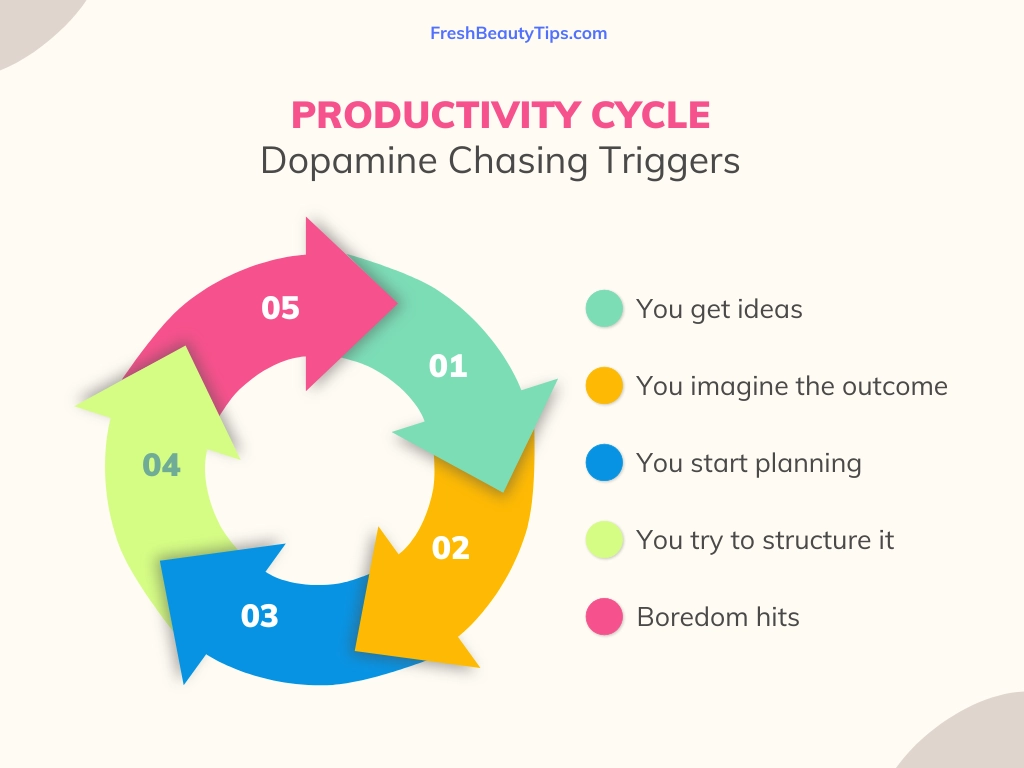
Another mechanism at play is known as reward prediction error. When you are brainstorming or planning, the potential reward is open ended. Your brain cannot accurately predict the outcome, so dopamine remains elevated. Once you move into execution, the task becomes structured and predictable. The brain can now forecast the likely reward more accurately and the dopamine spike diminishes. So the cycle continues, as does the dopamine chasing.
It also creates a subtle, but powerful learning pattern: beginnings feel exciting, repetition feels flat. This isn’t lack of capability. It’s your brain preferring possibility over commitment. If you consistently abandon projects during the novelty drop, your brain begins associating starting with stimulation and finishing with discomfort. Over time, this can evolve into a cycle of chronic initiation and incomplete execution.
The Core Issue of Chasing Dopamine
The core issue of chasing dopamine in a productivity sense is that you become addicted to the feeling of progress instead of actual progress. More specifically, you train your brain to associate reward with starting, planning, and imagining rather than executing and finishing. Since dopamine spikes most strongly in anticipation, your brain starts preferring:
- Brainstorming over building
- Planning over executing
- Researching over releasing
- Pivoting over persisting
But, true productivity requires staying with something long enough for effort to accumulate. During repetition, neural circuits become more efficient. The brain shifts processing from heavy effort prefrontal networks toward more automated pathways. This transition feels less exciting precisely because it is becoming integrated. The individuals who build expertise are not those who feel continuously inspired; they are those who can tolerate the dip between excitement and mastery. So the real skill you need isn’t “better planning,” it’s staying with something after the excitement fades.
Why Some Experience Dopamine Chasing More Intensely
For individuals with ADHD or strong novelty seeking traits, the contrast between ideation and execution can feel even sharper. Research supported by the National Institute of Mental Health suggests that ADHD involves differences in dopamine regulation and executive functioning. Task initiation and sustained effort are particularly difficult when rewards are delayed or abstract.
This explains a common paradox: high performance under urgency and low consistency under self directed structure. Urgency increases dopamine. Deadlines increase dopamine. High emotional stakes increase dopamine. But long term projects that require incremental, repetitive effort offer no immediate spike with a distant reward.
In these cases, the brain struggles to generate sufficient motivation without external stimulation. This does not reflect laziness. It reflects a reward system that is calibrated toward immediacy. In modern work environments, especially entrepreneurial or creative ones, novelty is abundant with new tools, new strategies, new platforms, and new directions. Each option offers a fresh anticipatory reward.
Without conscious constraints, the brain will naturally gravitate toward the next stimulating possibility. That’s because ideas are infinite and execution is narrowing. Narrowing feels like loss, so ultimately you stay in expansion mode because it is stimulating.
The Fix for Chasing Dopamine
You may think in order to fix chasing dopamine, it would require more structure. Stricter schedules, more detailed calendars, additional rules. Structure can help, but if it feels restrictive, the reward system will resist it. For novelty driven brains, rigid confinement reduces stimulation and increases avoidance. The solution is not maximum control, it is intentional constraint. You need enough structure to reduce decision fatigue, but enough flexibility to prevent psychological suffocation.
Creating Constrained Flexibility
When chasing dopamine is the problem, it’s crucial to remember that the goal to manage it is not to eliminate dopamine. It is to retrain the reward association that is triggering it. Luckily, this is possible and you can start building a system that works for you right away. This is done using constrained flexibility. Meaning, you are giving yourself just enough novelty to stay stimulated, but adding small constraints to help you maintain boundaries. The system will:
- Capture ideas without acting on them immediately
- Limit execution lanes
- Allow novelty inside boundaries
- Remove daily decision fatigue
Right now, your reward system likely fires strongest at the moment of possibility, when you start, plan, or imagine. So to build consistency, you need to shift that spike toward finishing. But how do you actually implement this idea of constrained flexibility? We believe it can be done by implementing four shifts:
1. Separate Idea Generation From Execution
Most people mix creativity and execution together, but what you really need is two clearly different places for your work. Do this by creating two lists: Idea Bank and Active List. The idea bank can be free, chaotic, and infinite, it’s where any idea that pops up goes. But, the active list is where your main focus must be. It needs to stay small (commit to no more than 3 items on the active list) to work on until completion.
The hardest, but most important aspect of this is: when a new idea hits, it goes in the bank. It does not get promoted automatically. This works because it maintains a dedicated space for ideas, but limits the number of active projects, preserving novelty without allowing it to hijack focus. It also protects your current focus without suppressing creativity.
2. Restrict Simultaneous Commitments
If you constantly feel busy, but rarely feel finished, it’s likely due to having too many things you’re working on at once. Every unfinished project drains attention in the background. Even if you’re not working on it, your brain knows it’s open. That mental clutter makes new ideas even more appealing. So you need a hard cap.
When active projects are capped, finishing becomes necessary before starting something new, and completion begins to carry its own reward. Instead of getting the thrill from idealizing, you get the reward from clearing something off your plate. This is ultimately retraining or rewiring what your brain associates with reward. Completion becomes the unlock.
3. Expect the Boring Phase
We know that for novelty seeking brains, every project has a moment where it stops being exciting. This is the danger zone, and often where people get off track. But, it’s also the most important moment for shifting the dopamine to actually finish what you start. Most people interpret this moment as:
- “Maybe this isn’t the right direction.”
- “Maybe I’m not that interested.”
- “Maybe this idea isn’t good enough.”
But often, nothing is wrong, it’s just that the excitement has worn off. So be prepared. Expect this drop, so you can recognize when it creeps in. Then, give yourself a rule: once the excitement fades, I will work on this for five more focused sessions before I reconsider it. That pause prevents emotional decisions, and allows real progress to happen.
4. Build a Repeating Structure
This is where the structure comes in. Create simple, repeatable patterns so that fewer daily decisions are required and you have more energy for execution. If every week requires new decisions (what to post, when to work, what order to do things) your brain burns energy just choosing. When you’re mentally tired, you’re more likely to chase something new and exciting instead of finishing something repetitive. So reduce the choices. For example, choose the same time for work blocks each week (without specifying what you’re working on in them), create a template for similar projects, or choose the day of the week you want to have the final version completed.
Remember, consistency isn’t about being rigid, it’s about conserving energy for what matters, so start small, and build from there. This structure helps strengthen the reward system by chasing dopamine at the completion of these small wins.
The Last & Ultimate Shift Needed with Dopamine and Productivity
This idea is subtle but powerful: change what you’re proud of. If you take pride in being “the ideas person,” you will keep generating ideas. If you admire yourself for being creative, visionary, or full of potential, you will unconsciously protect that identity. But potential doesn’t build anything, finishing does. You can shift this by intentionally celebrating completion:
- Track what you finish, not what you start
- Keep a visible “Done List”
- Notice the relief and clarity that follow completion
Over time, your brain starts associating satisfaction with closure, not just possibility. That’s when your productivity truly changes.